|
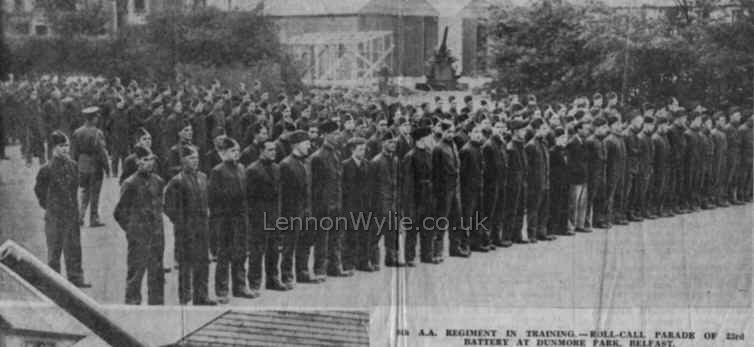
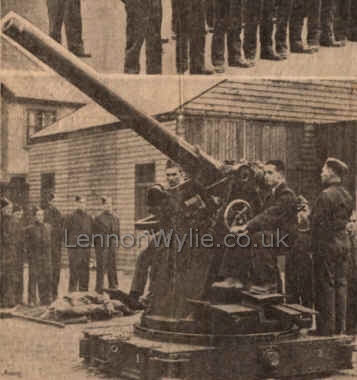
8th A.A. Regiment in Training - Roll Call
Parade of 23rd Battery at Dunmore Park, Belfast
|
 |
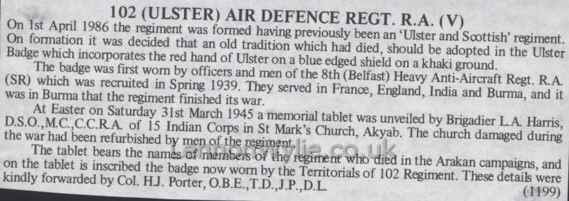
102 (ULSTER) AIR DEFENCE REGT. R.A. (V)
On 1st April 1986 the regiment was formed having
previously been an 'Ulster and Scottish' regiment. On
formation it was decided that an old tradition which had died,
should be adopted in the Ulster Badge which incorporates the red
hand of Ulster on a blue edged shield on a khaki ground. The
badge was first worn by officers and men of the 8th (Belfast) Heavy
Anti-Aircraft Regt. R.A. (SR) which was recruited in Spring 1939.
They served in France, England, India and Burma, and it was in Burma
that the regiment finished its war.
At Easter on Saturday 31st March 1945 a memorial tablet was unveiled
by Brigadier L. A. Harris, D.S.O., M.C., C.C.R.A., of 15 Indian
Corps in St. Mark's Church, Akyab. The church damaged during
the war had been refurbished by men of the regiment. The
tablet bears the names of members of the regiment who died in the
Arakan campaigns, and on the tablet is inscribed the badge now worn
by the Territorials of 102 Regiment. These details were kindly
forwarded by Col. H. J. Porter, O.B.E., T.D., J.P., D.L. |
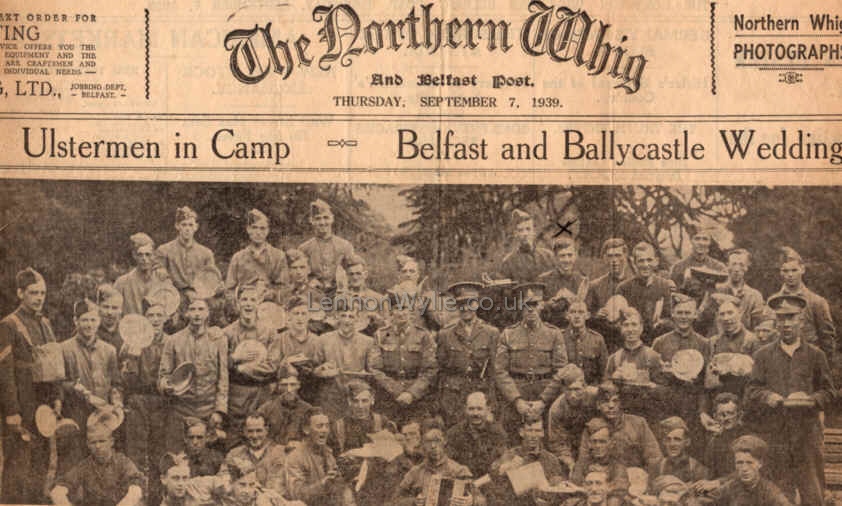
The Northern Whig, September 7th, 1939
Ulstermen in Camp 1939 (Jim Lennon X)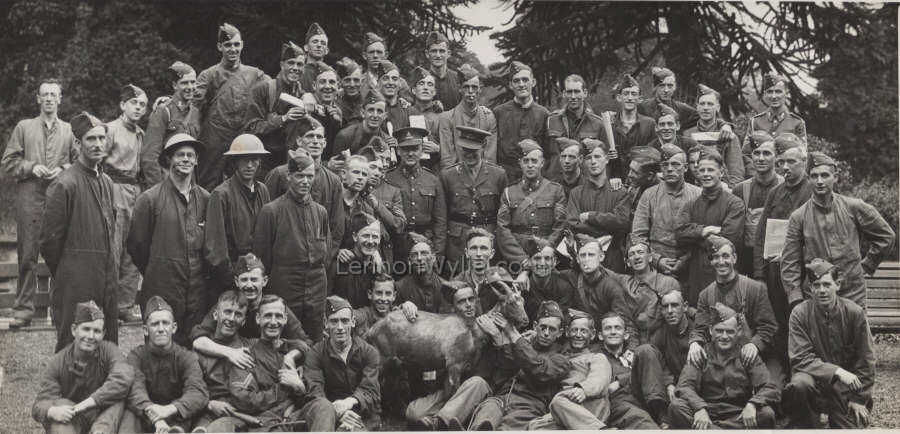
The Northern Whig, September 8th, 1939
Ulstermen in Camp 1939 (Jim Lennon X)
Another picture of Ulstermen in Camp - The goat is a great ? with
the Troops
[ the man with his hands on the
shoulders of the man 2nd from right at front is John
Blair thank you to his great-granddaughter
Amy Gibson for contacting me]
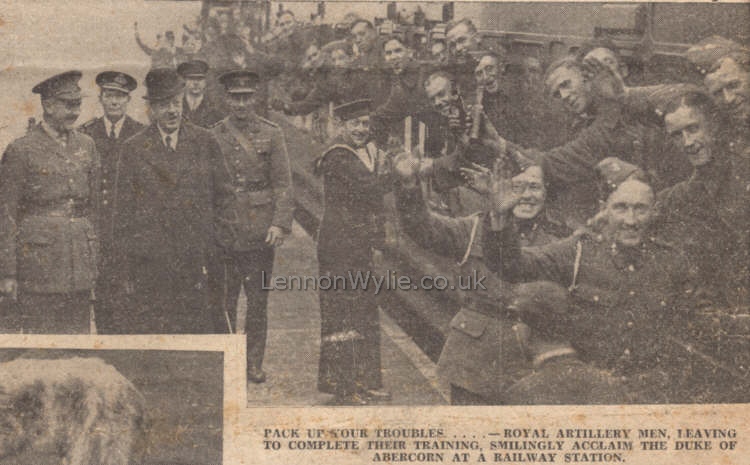
Pack up your troubles..... Royal
Artillery Men, leaving to complete their training, smilingly,
acclaim the Duke of Abercorn at a Railway Station
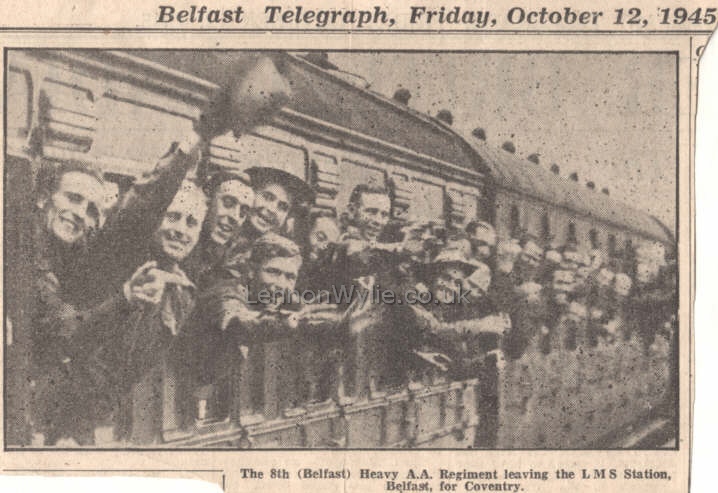
Belfast Telegraph Friday, October 12,
1945
The 8th (Belfast) Heavy A.A. Regiment leaving the LMS Station,
Belfast, for Coventry.
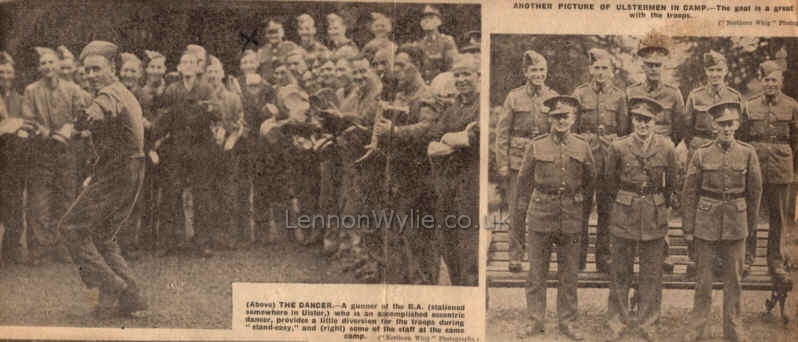
The Northern Whig, September 8th, 1939
Ulstermen in Camp, The Dancer (Jim Lennon X)
The Dancer - A gunner of the R.A. (stationed somewhere in Ulster,_
who is an accomplished eccentric dancer, provides a little diversion
for the troops during "stand-easy,"
and (right) some of the staff at the same camp.
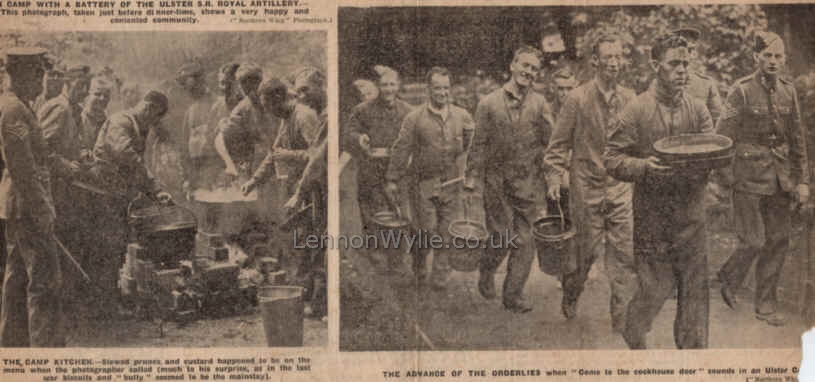
The Northern Whig (1939?)
A camp with a Battery of the Ulster S.R. Royal Artillery - This
photograph, taken just before dinner-time, shows a very happy and
contented community.
The Camp Kitchen - Stewed prunes and custard happened to be on the
menu when the photographer called (much to his surprise, as in the
first war biscuits and "bully" seemed to be the mainstay).
The Advance of the Orderlies when "Come to the cookhouse
door" sounds in an Ulster Camp.
|
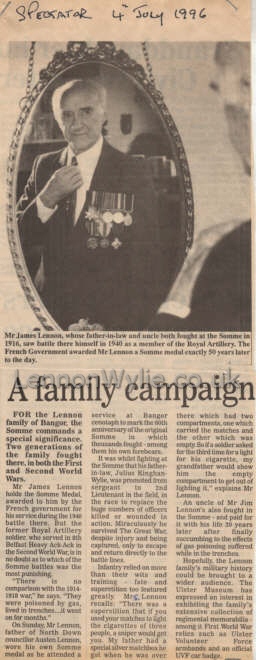 |
Spectator
Newspaper, Bangor, 4th July 1996
Mr. James Lennon, whose father-in-law and uncle both fought at the
Somme in 1916, saw battle there himself in 1940 as a member of the
Royal Artillery. The French Government awarded Mr. Lennon a Somme
medal exactly 50 years later to the day.
A family campaign
For the Lennon family of Bangor, the Somme commands a special
significance. Two generations of the family fought there, in both
the First and Second World Wars.
Mr. James Lennon holds the Somme Medal, awarded to him by the French
government for his service during the 1940 battle there. But the
former Royal Artillery soldier, who served in the 8th Belfast Heavy
Ack-Ack in the Second World War, is in no doubt as to which of the
Somme battles was the most punishing.
"There is no comparison
with the 1914-1918 war," he says. "They were poisoned by
gas, lived in trenches........it went on for months."
On Sunday, Mr. Lennon, father
of North Down councillor Austen Lennon, wore his own Somme medal as
he attended a service at Bangor cenotaph to mark the 80th
anniversary of the original Somme in which thousands fought - among
them his own forebears. It was whilst fighting at the Somme that his
father-in-law, Julius Kinghan (Keenan) Wylie, was promoted from
sergeant to 2nd Lieutenant in the field, in the race to replace the
huge numbers of officers killed or wounded in action. Miraculously
he survived The Great War, despite injury and being captured, only
to escape and return directly to the battle lines. Infantry relied
on more than their wits and training - fate and superstition too
featured greatly.
Mr(s). Lennon recalls;
"There was a superstition that if you used your matches to
light the cigarettes of three people, a sniper would get you. My
father had a special silver matchbox he got when he was over there
which had two compartments, one which carried the matches and the
other which was empty. So id a soldier asked for the third time for
a light for his cigarette, my grandfather (father) would show him
the empty compartment to get out of lighting it." explains Mr(s).
Lennon.
An uncle of Mr. Jim Lennon's
also fought in the Somme - and paid for it with his life 20 years
later after finally succumbing to the effects of gas poisoning
suffered which in the trenches. Hopefully, the Lennon family's
military history could be brought to a wider audience. The Ulster
Museum has expressed an interest in exhibiting the family's
extensive collection of regimental memorabilia - among it First
World War relics such as Ulster Volunteer Force armbands and an
official UVF car badge.
|
|
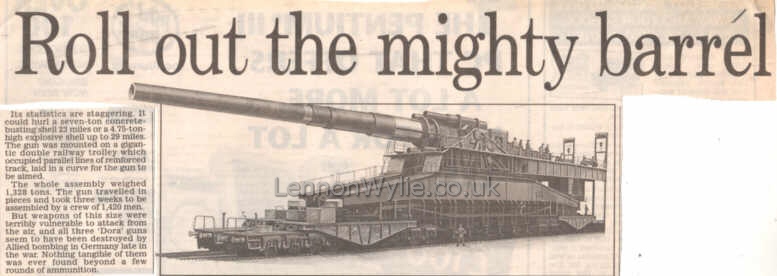
Not a girl to
trifle with: Dora, the largest gun in World War II, shows off the
size of her punch.
Roll out the mighty barrel
It's statistics are staggering. It could hurl a seven-ton
concrete-busting shell 23 miles or a 4.75-ton high explosive shell
up to 29 miles. The gun was mounted on a gigantic double railway
trolley which occupied parallel lines of reinforced track, laid in a
curve for the gun to be aimed. The whole assembly weighed 1,328
tons. The gun travelled in pieces and took three weeks to be
assembled by a crew of 1,420 men. But weapons of this size were
terribly vulnerable to attack from the air, and all three 'Dora'
guns seem to have been destroyed by Allied bombing in Germany late
in the war. Nothing tangible of them was ever found beyond a few
rounds of ammunition.
Tale of French
Treachery by Philip Kerr
The French behaved disgracefully during the Second World War and it
continues to astonish many, myself included, that France was allowed
to pose as one of the four victorious powers after the defeat of
Germany. What most people fail to realise is that the Germans needed
a force of a little more than 3,000 men - half the size of the Paris
police force - to garrison the whole of France during the
Occupation. The reality of the situation was that most Frenchmen
were willing collaborationists and enthusiastic racists. Petain's
regime introduced anti-Jewish regulations in France without any
prompting from the Germans. Resistance to the Occupation was small
and piecemeal and, where it was most efficient, largely Communist.
Yet even the French Communist Party, confused by the Nazi-Soviet
pact of 1939, had toed the party line and joined the Vichy
government. It wasn't until 1941, when Hitler invaded the Soviet
Union, that Communist resistance got going. They were just as likely
to kill members of other resistance groups - Gaullists, for example
- as they were to kill Germans. It seems almost unthinkable to us,
50 years after, but this was the reality of Nazi France. Let's call
a spade a spade: France was just as much a Nazi country as Austria
was. |
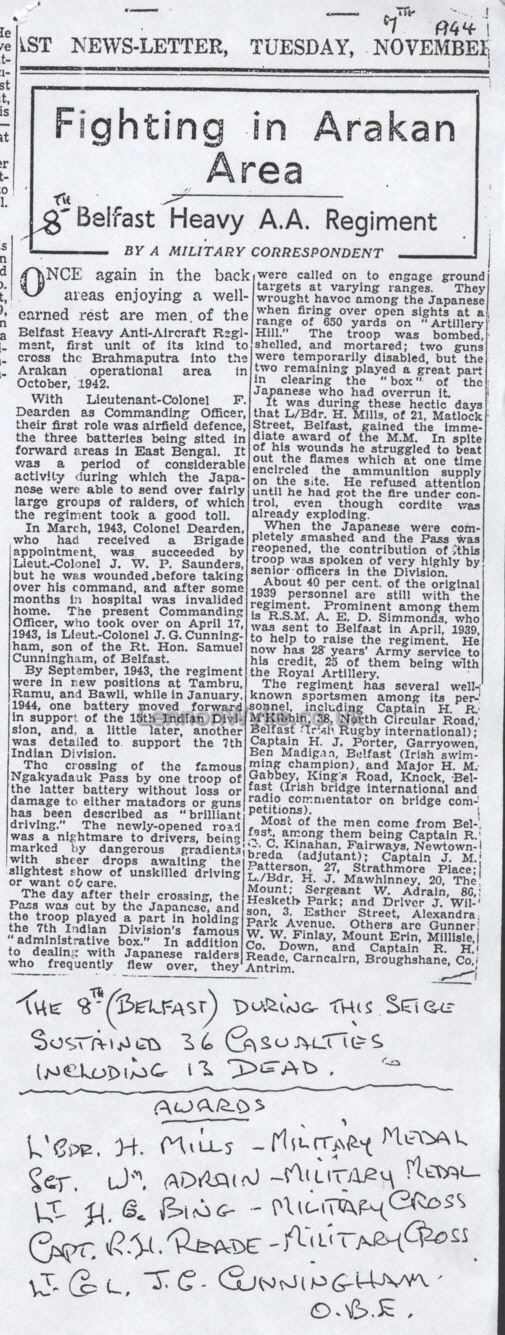
my father wrote on this clipping...
The 8th (Belfast) during this siege
sustained 36 Casualties including 13 dead.
Awards
L/Bdr. H. Mills - Military Medal
Sgt. Wm. Adrain - Military Medal
Lt. H. G. Bing - Military Cross
Capt. R. H. Reade - Military Cross
Lt. Col. J. G. Cunningham - O.B.E. |
BELFAST
NEWS-LETTER, TUESDAY 7th NOVEMBER 1944
FIGHTING IN ARAKAN AREA
8th Belfast Heavy A.A. Regiment
by a Military Correspondent
Once
again in the back areas enjoying a well-earned rest are men of the
Belfast Heavy Anti-Aircraft Regiment, first unit of its kind to cross
the Brahmaputra into the Arakan operational area in October
1942. With Lieutenant-Colonel F. Dearden as Commanding Officer,
their first role was airfield defence, and three batteries being
sited in forward areas in East Bengal. It was a period of
considerable activity during which the Japanese were able to send
over fairly large groups of raiders, of which the regiment took a
good toll.
In March, 1943, Colonel Dearden, who had
received a Brigade appointment, was succeeded by Lieut.-Colonel J. W.
P. Saunders, but he was wounded before taking over his command, and
after some months in hospital was invalided home. The present
Commanding Officer, who took over on April 17, 1943, is
Lieut.-Colonel J. G. Cunningham, son of the Rt. Hon. Samuel
Cunningham, of Belfast.
By September, 1943, the regiment were in new
positions at Tambru, Ramu and Bawli, while in January, 1944, one
battery moved forward in support of the 15th Indian Division, and a
little later, another was detailed to support the 7th Indian
Division.
The crossing of the famous Ngakyadauk Pass
by one troop of the latter battery without loss or damage to either
matadors or guns has been described as "brilliant
driving." The newly opened road was a nightmare to
drivers, being marked by dangerous gradients with sheer drops
awaiting the slightest show of unskilled driving or want of care.
The day after their crossing, the Pass was
cut by the Japanese, and the troop played a part in holding the 7th
Indian Division's famous "administrative box." In
addition to dealing with Japanese raiders who frequently flew over,
they were called on to engage ground targets at varying ranges.
They wrought havoc among the Japanese when firing over open sights at
a range of 650 yards on "Artillery Hill." The troop
was bombed, shelled, and mortared; two guns were temporarily
disabled, but the two remaining played a great part in clearing the
"box" of the Japanese who had overrun it.
It was during these hectic days that L/Bdr.
H. Mills, of 21 Matlock Street, Belfast, gained the immediate award
of the M.M. In spite of his wounds he struggled to beat out the
flames which at one time encircled the ammunition supply on the
site. He refused attention until he had got the fire under
control, even though cordite was already exploding.
When the Japanese were completely smashed
and the Pass was reopened, the contribution of this troop was spoken
of very highly by senior officers in the Division. About 40% of
the original 1939 personnel are still with the regiment. Prominent
among them is R.S.M. A. E. D. Simmonds, who was sent to Belfast in
April, 1939, to help to raise the regiment. He now has 28
years' Army service to his credit, 25 of them being with the Royal
Artillery.
The regiment has several well known
sportsmen among its personnel, including Captain H. R. McKibben, 38
North Circular Road, Belfast, (Irish Rugby International); Captain H.
J. Porter, Garryowen, Ben Madigan, Belfast (Irish Swimming champion)
and Major H. M. Gabbey, King's Road, Knock, Belfast (Irish bridge
international and radio commentator on bridge competitions).
Most of the men come from Belfast, among
them being Captain R. C. C. Kinahan, Fairways, Newtownbreda
(adjutant); Captain J. M. Patterson, 27 Strathmore Place; L/Bdr. H.
J. Mawhinney, 20 The Mount; Sergeant W. Adrain, 86 Hesketh Park; and
Driver J. Wilson, 3 Esther Street, Alexandra park Avenue.
Others are Gunner W. W. Finlay, Mount Erin, Millisle, Co. Down, and
Captain R. H. Reade, Carncairn, Broughshane, Co. Antrim. |
Belfast A.A. Men Clear the Ground
Ulster men of the 8th Belfast Heavy Anti-Aircraft Regiment, who, in
the early days of the war, manned their guns in defence of the city,
are today firing at Japanese troops on the Arakan front at
point-blank range.
With the Japanese airmen almost driven from Burma's
skies, these Belfast gunners fire mostly at enemy ground targets.
Less than a week before I met these men, writes a 14th Army
Observer, one battery of the regiment had fired on about 100 of the
enemy across open paddy-fields near the Mayu River. Before the
enemy were able to take cover 40 Japanese were lying dead, dying or
wounded. Another battery recently fired at an enemy 150 mm.
gun position south-west of Buthidaung. When the infantry
reached the enemy position they found 17 dead Japanese sprawled
around their gun which had been destroyed by a direct hit. The
Regiment has taken part in many actions in Burma since late 1942.
The Regiment was raised in April 1939, mobilised in
August and defended the skies over Belfast until October.
First Christmas of the war was spent at Le Havre. Later they
moved forward. One battery, overrun by the Germans, made its
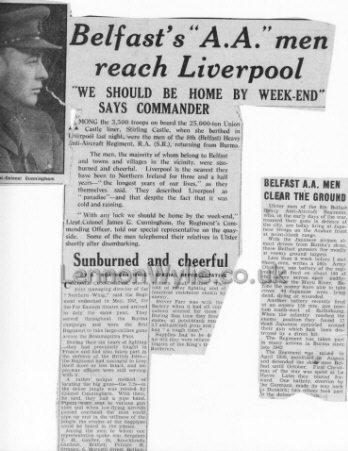
way back to Dunkirk; two others took part in the defence of Calais? |
Belfast's "A.A." men reach Liverpool
"We should be home by
Week-end" says Commander
('my dad tells me that when they arrived at Liverpool there was one
woman and a pram and a small child waiting to greet them' in
comparison Belfast was alive with people when they arrived there)
Among the
3,500 troops on board the 25,000-ton Union Castle liner, Stirling
Castle, when she berthed in Liverpool last night, were the men of
the 8th (Belfast) Heavy Anti-Aircraft Regiment, R.A. (S.R.)
returning from Burma.
The men, the majority of whom belong to Belfast and towns and
villages in the vicinity, were sun-burned and cheerful.
Liverpool is the nearest they have been to Northern Ireland for
three and a half years - "the longest years of our lives," as they
themselves said. They described Liverpool as "paradise" - and
that despite the fact that it was cold and raining.
"With any luck we should be home by the week-end," Lieut.-Colonel
James G. Cunningham, the Regiment's Commanding Officer, told our
special representative on the quayside. Some of the men
telephoned their relatives in Ulster shortly after disembarking.
Sunburned and cheerful
by a "Northern Whig" special representative
Colonel Cunningham, who is joint managing director of the "Northern
Whig," said the Regiment embarked in May, 1942, for the Far Eastern
theatre and arrived in July the same year. They served
throughout the Burma campaign and were the first Regiment to take
large-calibre guns across the Brahmaputra Pass. During their
six years of fighting - they had previously fought in France and had
also taken part in the defence of the British Isles - the Regiment
had managed to keep itself more or less intact, and ten pre-war
officers were still serving with it.
A rather unique method of locating the big guns - the 7.2s - in the
dense jungle was related by Colonel Cunningham. With them, he said,
they had a pipe band. Pipers were sent to various gun sites and when
low-flying aircraft passed overhead the men could pipe up and in the
stillness of the jungle the strains of the bagpipes could be heard
in the planes. Among the men to whom our representative spoke
was Sergeant T. H. Coulter, 28 Knockbreda Gardens, Belfast; Private
R. Stranex, 6 Morpeth Street, Belfast; ???, Lisburn Road, Belfast.
They told of bitter fighting and of fanatical resistance shown by
the enemy.
Driver Farr was with the ? Battery when it had all communications
severed for three? During that time they fired ? enemy at
point-blank range ? 3.7 anti-aircraft guns and ? had "a tough time."
Supplies had to be dropped by air until they were
relieved ? contingent of the King's Own ? Borderers. (a piece of the
newspaper was torn) |
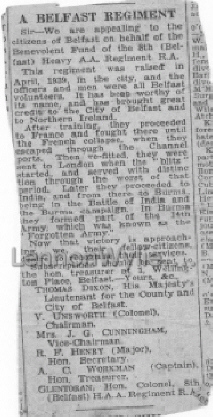 |
A
BELFAST REGIMENT
Sir - We are appealing to the
citizens of Belfast on behalf of the Benevolent Fund of the 8th
(Belfast) Heavy A.A. Regiment, R.A.
This regiment was raised in April, 1939, in the city,
and the officers and men were all Belfast volunteers. It has
been worthy of its name, and has brought great credit to the City of
Belfast and to Northern Ireland.
After training, they proceeded to France and fought
there until the French collapse, when they escaped through the
Channel ports. Then re-fitted, they were sent to London when
the "blitz" started, and served with distinction through the worst
of that period. Later they proceeded to India, and from there
to Burma, being in the Battle of India and the Burma campaign.
In Burma they formed part of the 14th Army, which was known as the
"Forgotten Army."
Now that victory is approaching, we, their
fellow-citizens, desire to recognise their services.
Subscriptions should be sent to the hon. treasurer at 1
Wellington Place, Belfast
Yours, etc., Thomas
Dixon, His Majesty's Lieutenant for the County and City of Belfast
V. Unsworth (Colonel), Chairman - Mrs. J. G. Cunningham,
Vice-Chairman (Mr.) - R. F. Henry (Major), Hon.
Secretary - A. C. Workman (Captain), Hon. Treasurer
- Glentoran, Hon. Colonel, 8th (Belfast) H.A.A. Regiment R.A. |
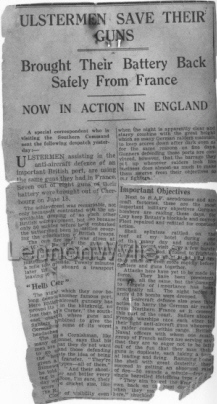 |
ULSTERMEN SAVE THEIR GUNS
Brought their battery back safely
from France
NOW IN ACTION IN ENGLAND
A
special correspondent who is visiting the Southern Command sent the
following despatch yesterday :-
Ulstermen assisting in the anti-aircraft defence of an
important British port, are using the same guns they had in France.
Seven out of eight guns of their battery were brought out of
Cherbourg on June 18.
The achievement was remarkable, not only because it
contrasted with the unavoidable dumping of so much other British war
equipment, but also because only 50 minutes before being embarked
the battery has been in position covering the embarkation of British
troops.
The cease fire order was given at 10.10 p.m. By 10.40?
(newspaper is creased and hard to make out) the guns had been
dismantled and spare ammunition blown up and the guns and valuable
instruments brought three-quarters of a mile to the dockside.
Twenty minutes later they were aboard a transport leaving the port. |
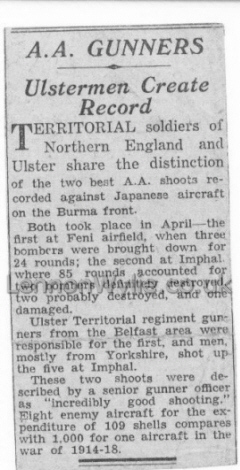 |
A.A. GUNNERS
Ulstermen Create Record
Territorial
soldiers of Northern England and Ulster share the distinction of the
two best A.A. shoots recorded against Japanese aircraft on the Burma
front.
Both took place in April - the first at Feni airfield, when three
bombers were brought down for 24 rounds; the second at Imphal, where
85 rounds accounted for two bombers definitely destroyed, two
probably destroyed, and one damaged.
Ulster Territorial regiment gunners from the Belfast area were
responsible for the first, and men, mostly from Yorkshire, shot up
the five at Imphal.
These two shoots were described by a senior gunner officer as
"incredibly good shooting."
Eight enemy aircraft for the expenditure of 109 shells compares with
1,000 for one aircraft in the war of 1914-1918 |
| |
|
| |
|
| |
|
| |
|
| |
|
| |
|
|